News · AI Integrations
OpenAI Presence Brings Managed Agents to Enterprise
OpenAI Presence packages governed voice and chat agents as a managed enterprise service. Here is what ships, who can access it, and what buyers should scrutinize.
The short version: OpenAI Presence is not another do-it-yourself agent builder. It is a managed product for enterprises that want OpenAI and selected integrators to help connect, test, launch, and continuously improve voice and chat agents. The product is available now through a limited program—not as self-service software.
What is OpenAI Presence?
Presence combines an AI agent with the operational controls needed to put it in front of customers or employees: company policies, standard operating procedures, approved actions, system permissions, simulations, evaluations, guardrails, and human-escalation rules.
Each deployment starts with one defined job. An agent might resolve a billing problem, assist with an insurance claim, or handle an employee IT request. The company determines which knowledge and systems the agent may access, what it can do without approval, and when a person must take over.
That makes Presence closer to a managed production system than a model API. OpenAI says its Forward Deployed Engineers and selected systems integrators help customers identify a workflow, connect systems, establish controls, test the agent, and launch it.
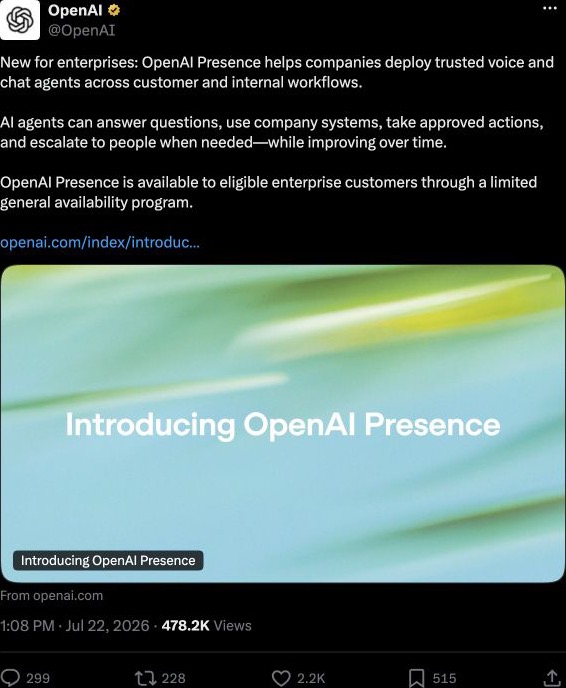
OpenAI announced Presence on X on July 22, 2026. Screenshot captured July 24, 2026.
What can an OpenAI Presence agent do?
OpenAI describes real-time voice and chat agents that can answer questions, use approved company systems, complete permitted actions, and escalate to a human. A billing agent, for example, could identify a caller, retrieve account information, apply a refund policy, and execute an approved adjustment.
The product has five notable layers:
| Layer | What it controls |
|---|---|
| Knowledge and access | The documents, account context, and internal systems available to a specific workflow. |
| Policies and actions | What the agent may say or do, which actions require approval, and which are prohibited. |
| Testing | Simulated routine, edge-case, and high-risk conversations evaluated with graders before launch. |
| Escalation | The conditions that transfer an interaction to a person. |
| Improvement | Production signals are reviewed; Codex proposes changes that teams can test and approve before rollout. |
Presence currently targets customer support, outbound sales, and higher-risk internal workflows. OpenAI names BBVA, SoftBank, and IAG as early design partners exploring banking, Japanese-language service, and insurance-support use cases respectively.
How is Presence different from an agent platform?
Most agent platforms give a company tools, APIs, and a console, then leave its team or implementation partner to assemble the production system. Presence packages more of that implementation and operating work into the product.
That has an obvious attraction: enterprise agents often fail after a convincing demo because policies change, integrations break, unusual requests appear, and nobody owns ongoing quality. Presence makes continuous evaluation and controlled updates part of the offer.
The tradeoff is equally important. A managed deployment can mean more vendor dependence, less architectural control, and a buying process that is slower than opening an API account. OpenAI has not published standard pricing, implementation timelines, service levels, or a self-service release date.
What performance evidence has OpenAI published?
OpenAI says Presence powers its English-language phone support line at 1-888-GPT-0090. According to the company, the agent now resolves 75% of incoming issues without human assistance, and a Codex-powered improvement loop reduced human handoffs by 15 percentage points in ten days.
Those numbers are useful proof that the system runs in production, but they are OpenAI’s own results, not an independent evaluation. The announcement does not publish call volume, issue mix, customer-satisfaction changes, error rates, repeat-contact rates, or the cost per resolved issue. All of those variables affect whether the headline resolution rate transfers to another business.
| Status | What we know |
|---|---|
| Confirmed product scope | Presence supports managed voice and chat deployments with policies, actions, evaluations, guardrails, and escalations. |
| OpenAI-reported result | Its own support agent resolves 75% of inbound issues without a person and reduced handoffs during a ten-day improvement period. |
| Early partner activity | BBVA, SoftBank, and IAG are exploring or testing specified use cases; the announcement does not claim broad production rollouts for all three. |
| Not yet disclosed | Standard pricing, contractual service levels, independent benchmarks, broad availability, and self-service access. |
Who can use OpenAI Presence now?
Presence is available to eligible enterprise customers through what OpenAI calls a limited general availability program. Deployments are led by OpenAI Forward Deployed Engineers and selected global systems integrators. It is not available as a self-service product.
Companies already using OpenAI’s models for voice applications can continue doing so through the API. Presence is the more hands-on option for organizations that want a packaged deployment and improvement process.
What should an enterprise ask before buying Presence?
The launch points toward a serious product, but the procurement questions matter more than the demo:
- Which data is retained from calls and chats, where is it processed, and who can review production sessions?
- Can every action be scoped by role, value, geography, and risk level?
- How are prompt injection, fraudulent callers, compromised tools, and poisoned knowledge sources tested?
- Which metrics define a correct resolution—not merely an avoided human handoff?
- Can the customer export policies, evaluations, transcripts, and improvement history?
- Who approves Codex-proposed changes, and how quickly can a bad release be rolled back?
- What happens when an upstream model changes?
- How are uptime, latency, support, and liability handled contractually?
OpenAI Presence is important because it shifts the enterprise-agent pitch from “build an agent” to “operate an accountable service.” Whether that service is trustworthy will be determined by access control, measurable outcomes, auditability, and escalation quality—not by conversational polish alone.
Frequently asked questions
- What is OpenAI Presence?
- OpenAI Presence is a managed enterprise product for deploying voice and chat agents. It combines models with company policies, approved actions, guardrails, evaluations, escalation rules, and an improvement workflow supported by Codex.
- Is OpenAI Presence available to everyone?
- No. OpenAI says Presence is in limited general availability for eligible enterprise customers. Deployments are led by OpenAI Forward Deployed Engineers and selected systems integrators; it is not currently self-service.
- Which workflows does OpenAI Presence support?
- OpenAI lists customer support, outbound sales, employee IT requests, billing, and insurance claims as examples. The product currently supports real-time voice and chat experiences.
- Does OpenAI Presence replace human support agents?
- It is designed to resolve approved tasks and escalate when policy or risk requires a person. OpenAI reports high automation on its own support line, but buyers should validate resolution quality, escalation behavior, and total cost in their own workflows.